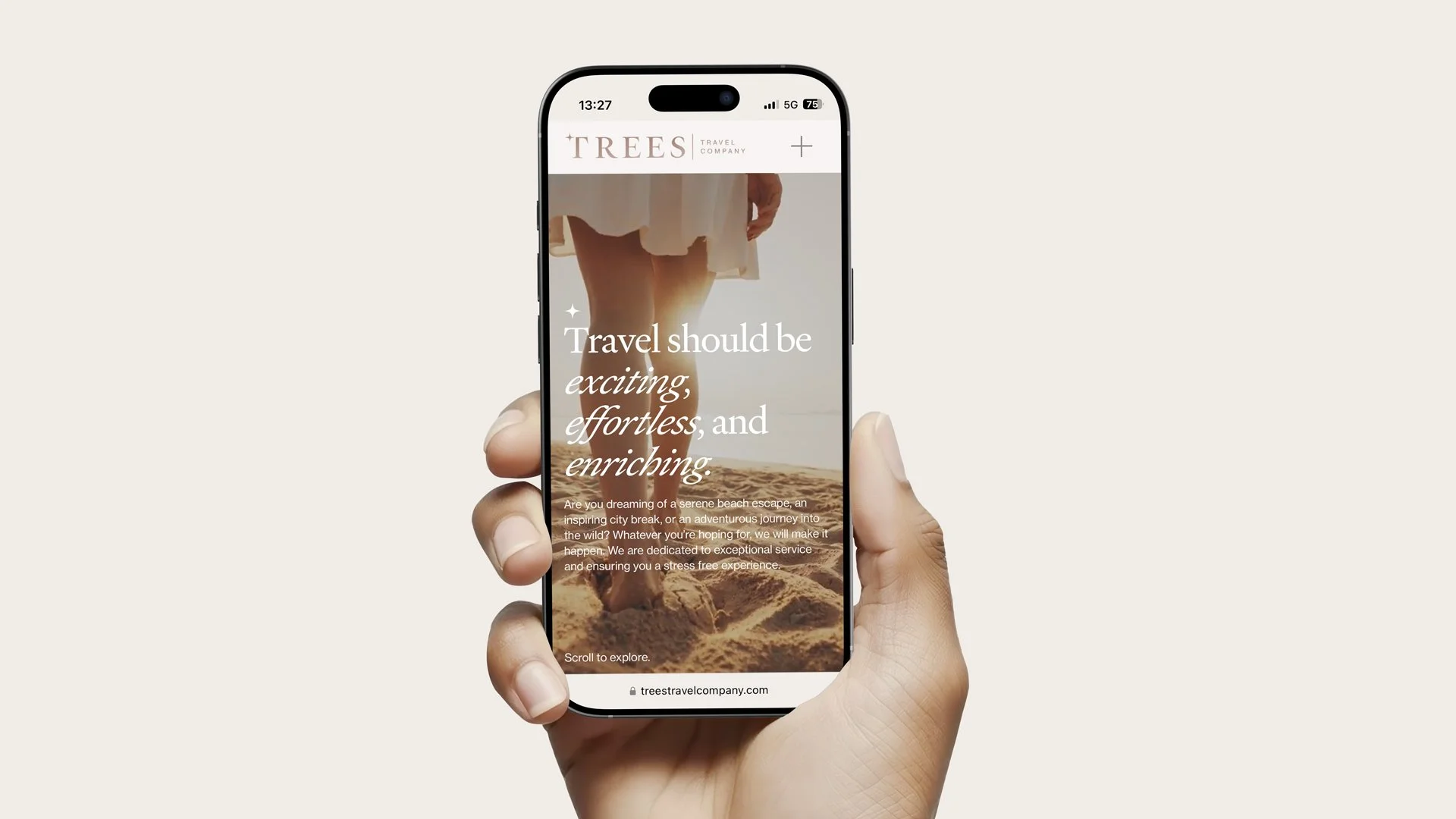
Brand tone of voice is the personality that comes through in every piece of writing a business produces, from a homepage headline to a refund email, and it shapes how people feel about a company before they ever meet anyone from it. Voice is the fixed, consistent identity behind the words; tone is the attitude that flexes with context while that voice stays the same. Consistency across channels builds trust faster, makes a business memorable, and separates it from competitors offering the same product or service. Most tone systems break down from trying to please everyone, drifting across channels, or being defined once and never documented, and the fix is a short, concrete reference built from traits, tone spectrums, and say/don't-say examples that any writer can follow. Visual identity and tone of voice work as one impression, and a polished logo paired with careless or inconsistent writing undercuts both.
Two coffee shops can sell the identical flat white, yet one makes you feel like a regular by the second visit and the other feels like a transaction. Often the difference isn't the coffee or the logo. It's the words. Your brand tone of voice is the personality that comes through in everything you write, from the headline on your homepage to the sign-off on a refund email, and it shapes how people feel about you long before they ever meet you.
Most small business owners pour their branding budget into the visual side (logo, colours, typography) and treat the words as an afterthought someone can bash out later. That's a mistake. It does as much heavy work as the logo, and this guide will walk you from what it really means through to a step-by-step way to define your own.
What Is Brand Tone of Voice?
Brand tone of voice is the distinctive way your business expresses itself in words: the vocabulary you reach for, the rhythm of your sentences, the level of formality, and the attitude behind it all. It's the written equivalent of a personality. When someone reads a page of your copy and thinks "these people sound warm" or "these people sound sharp and no-nonsense," that impression is your tone landing.
Think of it as how you'd describe a person you know. One friend is dry and understated. Another is enthusiastic and over-shares. A third is precise and never wastes a word. Brands work the same way. A strong brand tone of voice means a stranger could read three unrelated pieces of your writing and sense the same character running through all of them.
The word "voice" trips people up, because it sounds like it's about sound. It isn't. It's about consistent written character. Whether someone reads your Instagram caption, your invoice footer, or your out-of-office reply, they should feel they're dealing with the same recognisable business.
Brand Voice vs Tone vs Personality: What's the Difference?
These three terms get used interchangeably, and that's where a lot of confusion starts. They sit in a clear hierarchy, so it's worth pinning each one down.
Brand personality is the top of the stack. It's the set of human traits you want your brand to embody: playful, trustworthy, rebellious, caring. Personality is the character; voice and tone are how that character shows up in words.
Brand voice is your consistent identity in writing. It doesn't change. If your brand is warm and plain-spoken, it stays warm and plain-spoken across every channel and every mood. Voice is who you are.
Tone is the contextual attitude that flexes on top of your voice. It shifts depending on the situation, the same way your own voice with a friend stays yours whether you're celebrating good news or apologising for being late. You sound like you in both cases, but the attitude adjusts. A cheerful product launch and a serious service outage both come from the same voice, delivered in different tones.
| Element | What it is | Does it change? | Example |
|---|---|---|---|
| Personality | The human traits behind the brand | Rarely (only in a rebrand) | Friendly, sincere, calmly confident |
| Voice | Your consistent written identity | No, it stays fixed | Warm, plain, no jargon |
| Tone | The attitude adjusted for context | Yes, per situation | Upbeat on a launch, calm during a complaint |
Here's the practical takeaway: you define your voice once, and then you learn to shift tone without losing it. A business that changes its whole personality between a happy email and an apology reads as unstable. A business that keeps its voice but adjusts the tone reads as human.
Consistent tone builds trust faster and sounds intentional
Words are usually the first and most frequent contact people have with your brand. Someone might see your logo once, then read forty of your emails, captions, and product descriptions over the following year. That volume alone makes a consistent brand tone of voice a serious asset, not a nice-to-have.
Four things happen when your tone is deliberate and consistent:
- Trust builds faster. Consistency signals reliability. When your welcome email sounds like your website, which sounds like your support reply, people relax. Mismatched voices make a business feel like it's run by strangers who don't talk to each other.
- You become recognisable. A distinctive way of writing makes you memorable in a crowded market. People start to recognise your emails before they see the sender name.
- You stand apart from competitors. In sectors where everyone offers roughly the same service, tone is often the clearest point of difference. Two builders with identical skills can feel completely different based purely on how they write.
- You connect with the right people. The way you write filters your audience. A relaxed, funny tone pulls in people who want that and gently repels those who don't, which is exactly what good branding should do.
This is the part that gets overlooked when people think branding stops at the logo. Your visual identity gets you noticed; your words are what keep the relationship going. I've argued before that a brand is far more than a mark on a page, and tone of voice is one of the biggest pieces people leave out.
Four inputs shape how your brand should sound
You don't invent a tone of voice out of thin air. It grows out of four inputs, and the more clearly you understand each, the easier the writing becomes.
Your audience determines the baseline formality and vocabulary
Who you're talking to sets the baseline. A brand selling to chief financial officers writes differently from one selling skateboards to teenagers, and both are correct for their audience. The goal isn't to sound impressive; it's to sound like someone your customer would want to deal with. Match their level of formality, their vocabulary, and the amount of hand-holding they need.
Core values should leak into the way you write
What you care about should leak into how you write. If transparency is a core value, your tone will be plain and specific, allergic to spin. If craft matters most, your writing will be considered and precise. Values keep tone from being a costume you put on; they make it an extension of what the business already believes.
Context shifts tone within a consistent voice
The situation dictates the tone within your voice. A sales page can be confident and energetic. A page explaining a price rise needs to be calm, clear, and respectful. Same voice, different context, different tone. Getting this right is mostly about reading the room.
Channel changes the register while voice stays constant
Where the words appear changes how they should sound. A social caption can be loose and quick. A legal disclaimer can't be. Your voice threads through all of them, but the register moves. This is the same principle behind good branding process work, where every touchpoint is considered rather than treated in isolation.
Most brands blend two or three recognizable tone traits
Most brand tones are built from a handful of recognisable traits. You rarely pick just one; you blend two or three into something that feels like yours. Here are the common ones and when each earns its place.
- Friendly. Warm, approachable, uses everyday language and contractions. Best for brands that want to feel like a helpful human. Slack built much of its reputation on writing that feels like a considerate colleague rather than software.
- Professional. Polished, measured, credible. Suits consultancy, finance, healthcare, and any field where competence has to come through fast. Careful not to tip into cold or stiff.
- Authoritative. Confident and direct, takes clear positions. Good for experts and educators who want to be trusted as the ones who know. Works best when you back the confidence with genuine substance.
- Playful. Witty, light, unafraid of a joke. Powerful for consumer brands that want to feel fun, though it needs the right audience or it reads as trying too hard.
- Formal. Structured, precise, minimal slang. Appropriate for legal, government, and premium luxury contexts where restraint signals seriousness.
- Inspirational. Uplifting and motivating. Fits brands built around ambition, fitness, or personal growth. Overused, it drifts into empty motivational-poster territory, so keep it grounded.
The trick is specificity. "Friendly" alone is too vague to guide anyone. "Friendly like a knowledgeable neighbour, never gushing" gives a writer something real to aim at. The more precise your descriptors, the more consistent your writing.
A five-step framework builds a usable tone of voice
Here's a practical sequence you can run yourself. Give it a proper afternoon rather than ten rushed minutes, because the output feeds every word you write from here on.
Audit your existing writing to find where you clash
Gather ten pieces of your existing writing: homepage copy, a few emails, some captions, a proposal. Read them back to back and mark where they feel like the same brand and where they clash. Most businesses find at least one channel that sounds like a completely different company. That gap is your starting point.
Three or four personality traits hold the whole system together
Choose the human traits you want to come through. Keep it tight; more than four and nobody can hold them in their head while writing. Write each one as a short phrase, not a single word, so it carries actual instruction. "Confident without being arrogant" beats "confident."
Tone spectrums capture nuance better than single labels
This is the simple visual framework the topic usually lacks. Rather than picking labels, place your brand along a few sliders. For each one, mark roughly where you sit:
- Formal ⟵——————⟶ Casual
- Serious ⟵——————⟶ Playful
- Reserved ⟵——————⟶ Enthusiastic
- Matter-of-fact ⟵——————⟶ Poetic
Spectrums beat labels because they capture nuance. You might land three-quarters toward casual but only slightly toward playful, which is a very different brand from one that's fully casual and fully playful. Plotting it makes the decision concrete and gives every future writer the same map.
Say/don't-say examples remove guesswork for any writer
For each trait, give a do and a don't with real examples. This is the single most useful thing you can hand a writer. For instance:
Trait: Warm but not gushing
We say:    "Nice one, your order's on its way."
We don't:  "AMAZING NEWS!!! We are SO thrilled for you!!!"

Trait: Clear, no jargon
We say:    "We'll get your site live in two weeks."
We don't:  "We use agile methodologies to expedite deployment."
Concrete before-and-after examples remove the guesswork. Anyone can copy the pattern.
Document your tone in one or two pages people will read
Pull all of this into a short tone of voice section inside your brand guidelines: your traits, your spectrums, your say/don't-say examples, and a note on how tone shifts across a few key situations. It doesn't need to be a fifty-page manual. One or two well-made pages that people will read beats a doorstop nobody opens.
Voice stays constant across channels; tone shifts with context
A common gap in tone-of-voice advice is that it stops at written copy on a website, as if that's the only place your brand speaks. It isn't. Your voice needs to hold up across formats that behave very differently.
Social captions run fast and loose, so your tone can loosen with them, but the underlying voice stays put. Customer support chat is where tone matters most and gets neglected most, because it's usually the moment someone is frustrated. A calm, human reply that still sounds like your brand does more for loyalty than any clever ad. Video scripts need to sound right read aloud, which is a different test again, since some copy that looks fine on a page trips the tongue. Even automated messages, order confirmations, error pages, and chatbot replies are chances to sound like you rather than like a machine.
The rule across all of them is the same: voice fixed, tone flexed. If you can read your support emails and your product launch and hear the same character in both, the system is working.
Trying to please everyone dilutes your tone into nothing
A few pitfalls come up again and again, and each one undermines the effort without anyone noticing.
- Trying to appeal to everyone. A tone built to offend nobody ends up meaning nothing. Pick a clear character and accept it won't be for everyone. That's the point.
- Inconsistency across channels. A polished website paired with slapdash social posts reads as two different businesses. Consistency is the whole reason to bother.
- Mismatched tone and moment. Cheerful, jokey copy on an apology or a payment failure lands badly. Read the situation before you reach for your default setting.
- Copying a brand you admire. A tone that works for a big consumer name may sit completely wrong on your business. Borrow the discipline, not the personality.
- Defining it once and forgetting it. Tone drifts as more people write for you. Without a documented reference, it slowly dissolves back into whatever each individual feels like typing.
Test tone by removing your logo and asking what character emerges
Almost no guide talks about checking whether your tone is landing, which is odd, because you can. The simplest test is to remove your logo from a piece of copy and ask someone unfamiliar with your brand to describe the character behind it. If the words they use match your intended traits, your tone is doing its job. If they say "corporate and distant" when you were aiming for "warm," you've found a gap.
You can go further by trialling two versions of the same message, a subject line or a landing headline, and watching which one your audience responds to. Over time these small checks tell you whether the tone you designed is the tone people really experience.
Maintaining it is mostly about keeping the reference alive. When new people write for the brand, hand them the say/don't-say list before their first draft. As you scale, rebrand, or move into a new market, revisit the spectrums, since the audience and culture you're now speaking to may pull the sliders. If you're weighing bigger changes, it's worth thinking through the right moment to rebrand so your voice evolves on purpose rather than by accident.
Visual identity and tone of voice form one coherent impression
The strongest brands feel like one thing whether you're looking at them or reading them. The Maximum Turbine Support repositioning is a good illustration of that: a rebrand isn't only a fresh logo, it's a clearer, more confident way of speaking that runs through the whole site. Your visual identity and your brand tone of voice aren't two separate projects. They're two halves of the same impression, and they only work fully when they agree with each other.
If your logo says premium and your copy says bargain bin, people trust neither. Line them up and the effect compounds. That alignment is a big part of what I focus on when building a brand identity for a business, because a beautiful mark on top of scattered writing only gets you halfway.
Start with the audit. Pull up ten things you've written, read them in one sitting, and notice where they stop sounding like the same business. That gap is where your brand tone of voice work begins, and it's usually a lot more revealing than people expect.