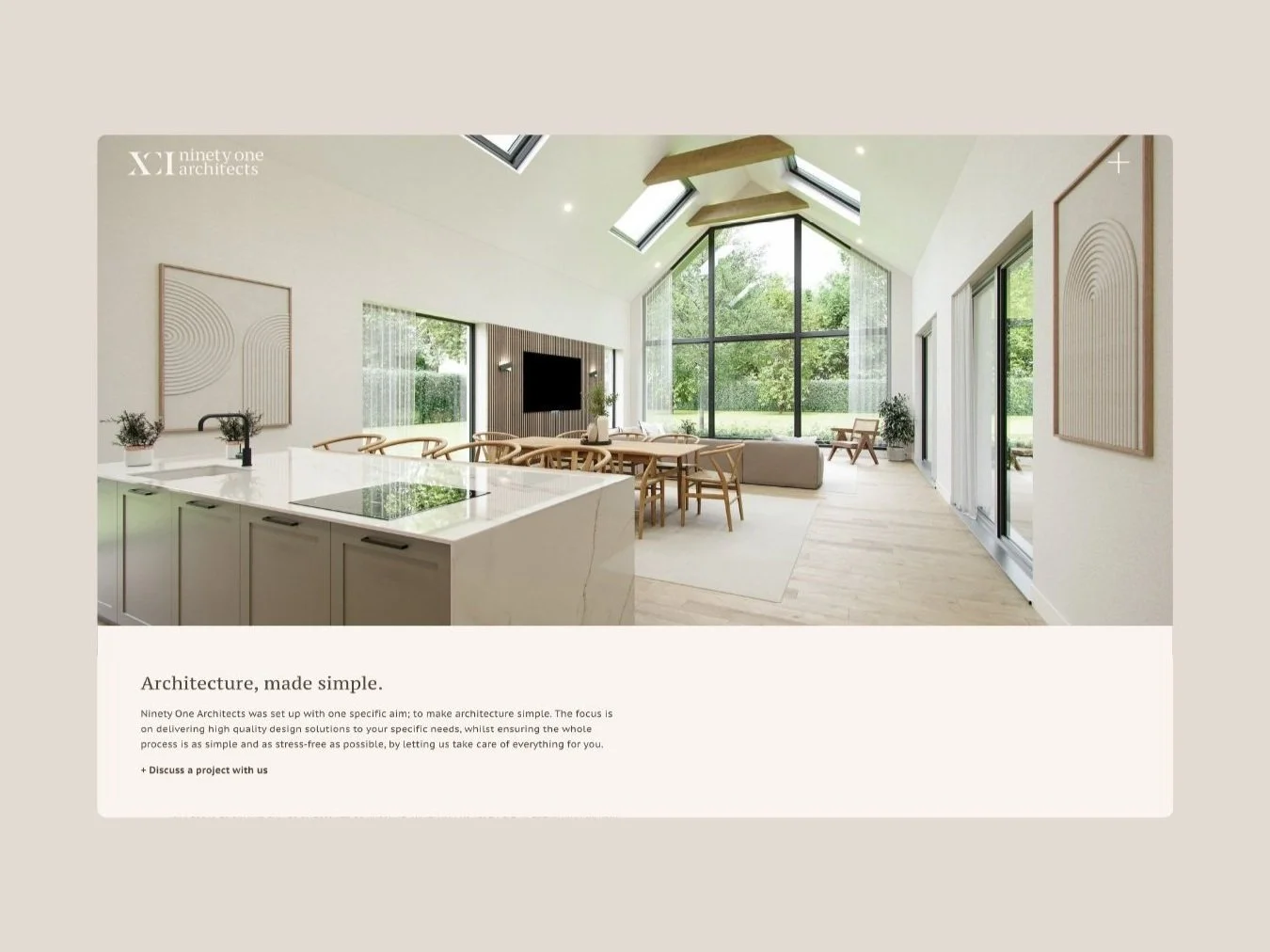
A specialist firm usually doesn't need more traffic. An architecture practice, a consultancy, a clinic, a surveying company: these businesses win a handful of clients a year, and each one might be worth more than a retail site makes in a quarter. That changes every decision inside a website redesign for specialist businesses, from how many pages you build to what the enquiry form asks.
Most redesign advice online is written for e-commerce or generic small business. It optimises for volume. Below are the questions that come up again and again on actual redesign calls with professional and specialist service firms, with direct answers for each.
What counts as a redesign versus a refresh?
A refresh keeps the structure and changes the surface: new typography, updated photography, tidier spacing, better buttons. A redesign changes the structure itself: the page map, the navigation, the content hierarchy, often the platform underneath.
The test is whether your current site's architecture can carry where the business is going. If you've added two service lines since the site was built and both are buried in a dropdown, no amount of new colour fixes that. If the layout is fine but the brand looks dated, you're probably looking at a refresh plus a visual identity update, which is cheaper and faster.
Specialist firms get this wrong in a specific way. They assume the site looks tired when the real problem is that it describes the firm they were five years ago. Reading your own homepage headline out loud is a surprisingly good diagnostic. If it doesn't describe the work you want more of, that's a positioning problem, and a prettier version of the same words won't help.
How do you know it's time for a website redesign for specialist businesses?
There are a handful of signals worth taking seriously. Most of the rest is vanity.
- Enquiries don't match the work you want. You're getting small residential jobs when you're pitching for commercial. The site is doing its job for the wrong audience.
- You can't add what you need to add. New service, new accreditation, new team page, and the template fights you every time.
- Prospects arrive already unsure. If the first thing people ask on a call is something your site should have answered, your content hierarchy is off.
- It fails on a phone. Not "it's a bit cramped" — hard to read, tap, or submit a form. Mobile-first isn't a trend for specialist firms, it's where the referral click lands.
- The site is slow enough to notice. Three seconds feels like forever to someone comparing you against two competitors on a Tuesday afternoon.
- Your brand moved and the site didn't. New logo, new positioning, same old website. That gap is visible to clients even when they can't name it.
Age alone isn't a reason. A five-year-old site that generates qualified enquiries, loads fast and ranks locally is doing better than plenty of sites built last month. Rebuild when the site blocks the business, not when it stops feeling fresh. The timing signals for a rebrand overlap heavily here, since brand and site usually drift out of date together.
Does a redesign work differently for a specialist firm than a retail business?
Yes, and the difference is mostly about volume and proof.
Retail redesigns chase conversion rate across thousands of sessions. Small improvements compound. A specialist redesign is working with far fewer visitors, many of whom arrive already warm from a referral, a tender shortlist or a LinkedIn profile. They're not browsing. They're checking whether you're credible enough to contact.
So the priorities invert. Instead of reducing friction across a long funnel, you're loading the first two screens with evidence: named projects, sectors served, accreditations, the scale of work you handle, who does the work. Credentials that would clutter a retail homepage belong near the top of a specialist one.
If one new client is worth five figures, a redesign only needs to win a single additional project to justify itself. That maths should shape what you build and what you skip.
It also changes what you measure. Tracking bounce rate on 400 monthly sessions tells you very little. Tracking whether the enquiries coming through are the right size, sector and budget tells you everything.
What should the redesign process look like?
A redesign that holds up runs through five stages. Skipping any of them is where projects go sideways.
- Audit. What's on the current site, what ranks, what gets traffic, what gets enquiries, what's broken. Export the URL list before anything else. You'll need it later for redirects.
- Strategy. Who the site is talking to, what one action matters most, what the page map needs to be. This is where you decide whether you need twelve pages or forty.
- Content. Written before design, not after. Specialist sites live on specifics, and nobody can design around placeholder text pretending to be a case study.
- Design and build. Desktop and mobile layouts, then the build itself, then testing on real devices rather than a browser window dragged narrow.
- Launch and monitor. Redirects live, analytics connected, sitemap submitted, then four to six weeks of watching rankings and enquiry flow before calling it done.
Content is the stage that stalls almost every project. A designer can move fast; a managing director who needs to write six case studies between client commitments cannot. If that's your situation, agree upfront who writes what and by when, or expect the timeline to double. The way a website build runs end to end is worth understanding before you commission one, so you know which stage you're the bottleneck in.
Will a redesign damage your search rankings?
It can, and this is the single most common way a good-looking redesign loses money. The risk isn't the design. It's the URLs.
When page addresses change and nothing tells Google where they went, much of the ranking strength those pages built up can be lost. A firm that ranked on page one for a core service term can drop out entirely because a service page moved from one path to another with no redirect behind it.
Protect against it with four things:
- Map old URLs to new ones before launch and set up 301 redirects for every page that changes address. No exceptions, including blog posts you think nobody reads.
- Keep your strongest pages' content rather than rewriting from scratch. Improve it, restructure it, but don't delete the paragraphs Google already associates with your service terms.
- Carry over page titles and meta descriptions on anything that currently ranks, then refine them after launch once things have settled.
- Submit the new sitemap the day you go live and check Search Console for crawl errors across the following fortnight.
Expect some turbulence regardless. Rankings often wobble for a few weeks while the new structure is crawled and reindexed, then recover and usually improve if the new site is faster and better organised. Panicking in week two and changing things again is how firms turn a dip into a decline. If search visibility is a weak spot generally, the fundamentals covered in this walkthrough of page titles, URLs and local search setup are worth sorting during the rebuild rather than after.
How long does a redesign take?
For a small specialist firm with ten to twenty-five pages, four to eight weeks is a realistic window from kickoff to launch when content is ready. Add a month or more if photography needs shooting, if content is being written from scratch, or if several partners need to sign off on every page.
The variables that move the timeline:
| Factor | Fast scenario | Slow scenario |
|---|---|---|
| Content | Written and approved before design starts | Drafted page by page during build |
| Approvals | One decision-maker | Partner group reviewing in rounds |
| Photography | Existing library is usable | Site visits and shoots to schedule |
| Functionality | Standard pages and an enquiry form | Booking, client portals, custom integrations |
| Brand assets | Current guidelines exist | Identity needs rebuilding first |
That last row catches people out. If your logo, type and colour system are inconsistent, the design stage turns into a branding exercise with a deadline attached. Sorting a usable set of brand guidelines first is slower on paper and faster in practice.
What does a redesign cost, and how should you budget for one?
Pricing varies enormously by scope, market and who's doing the work, so treat any number you see on an agency page as a starting bracket rather than a quote. The useful way to think about budget isn't a single figure but a split.
Roughly, a specialist firm's redesign budget breaks into design and build, content and photography, and anything technical beyond standard pages. Content and photography are the lines most firms underestimate, because they assume existing material will do. It rarely does. Project photos taken on a phone in bad light will undermine an otherwise strong site, particularly for architects, engineers and anyone selling visual craft.
Three practical rules:
- Decide your maximum before you ask for quotes, and say it out loud. Designers can scope to a budget; they can't guess it.
- Ask what's excluded, not just what's included. Hosting, domain, stock imagery, copywriting and post-launch changes are the usual gaps.
- Set aside something for the three months after launch. Small fixes and content additions always surface once real visitors arrive.
For a firm where one project pays for the whole rebuild several times over, spending at the low end to save a few thousand is usually a false economy. The site is a sales asset, not an overhead.
Should you hire a freelancer, an agency, or do it in-house?
Each path works for a different kind of firm, and the plain answer depends on how much of the work you're able to take on internally.
DIY works only if someone has design judgement and spare hours
Viable if someone on your team has genuine design judgement and the hours to spare. Modern builders make a tidy site achievable without code. What they don't give you is strategy: the page map, the positioning, the decision about what goes above the fold. Most DIY specialist sites fail not on looks but on structure — everything the firm does, listed flatly, with no sense of what matters most.
Agencies suit parallel workflows but add cost and account layers
Right when you need multiple disciplines running in parallel: strategy, copy, design, development, ongoing marketing. You get process and capacity. You also get account layers, higher cost, and sometimes a junior designer doing the actual work while the senior name sold it.
Freelancers work well for single-discipline projects at lower cost than studios
Right for small and medium specialist firms where one experienced person can hold the whole project. You deal directly with whoever's designing, decisions happen in a conversation rather than a change request, and the cost sits below agency rates. The constraint is capacity: a freelancer running three projects can't absorb a sudden scope expansion the way a studio can.
Whichever route you take, vet for fit rather than portfolio gloss. Does the designer understand that your sales cycle runs months, not minutes? Have they built anything where the goal was five qualified enquiries rather than five hundred sessions? Can they talk about structure and content, or only about visuals? The questions worth bringing to a first design call apply just as well to a web project as a branding one.
What should a specialist website include that a generic one doesn't?
Trust architecture, mostly. A retail visitor needs a price and a returns policy. Your visitor needs to believe you can handle their problem at their scale.
- Named case studies with outcomes. Not a gallery. The brief, the constraint, what you did, what resulted. Three strong ones beat twenty thumbnails.
- Credentials where they're visible. Chartered status, professional body membership, insurance levels, certifications. For regulated sectors these aren't decoration, they're qualification criteria.
- Real people. Specialist buyers hire humans. A team page with proper photography and actual biographies outperforms a stock image of a boardroom every time.
- Sector pages. If you serve healthcare, education and commercial clients, each deserves its own page speaking that sector's language. This is also how you pick up long-tail search.
- An enquiry form that qualifies. Project type, rough scale, timeline. Three extra fields cost you tyre-kickers and save you hours.
- Accessibility built in. For public sector work it's often contractual, and the difference between accessible and standard builds affects cost, so raise it at scoping rather than after.
What to leave out is equally useful. Live chat on a site with low traffic is a widget nobody staffs. Sliders on the homepage bury everything after the first slide. A blog you won't maintain looks worse after eight months of silence than no blog at all.
How do you measure whether the redesign worked?
Pick your metrics before launch, while you still have a baseline. After launch, you're guessing.
For a specialist firm, the ones that matter are enquiry volume, enquiry quality, and the proportion of enquiries that reach a proposal. A site that halves your enquiries while doubling the proportion worth quoting for is a clear win, even though the top-line number dropped. Secondary measures: rankings for your core service terms, organic traffic to sector pages, phone calls from the Google Business Profile, and page speed.
Give it three to six months before judging. Specialist sales cycles are slow, and a lead that lands in November might not sign until February. Reviewing performance four weeks after launch tells you the site works technically, not whether it works commercially.
FAQ
Is a website redesign for specialist businesses worth it if the current site still works?
A website redesign for specialist businesses is only worth it if the site is underperforming against what the business needs now. Working and performing aren't the same thing — a site can load fine, look acceptable and still send you the wrong enquiries or hide your best work three clicks deep. Audit the enquiries you received this year before deciding. If they match the work you want more of, leave it alone and spend the budget on visibility instead.
Should branding be sorted before the website?
Generally yes. Designing a site around an identity you're about to change means paying twice, and the second pass is never as clean as doing it in order. If your logo, colours and typography are inconsistent across documents and signage, that's the job to do first. Brand identity and website design handled as one piece of work also saves the handover friction between two suppliers.
Can you keep your existing platform or should you move?
Stay if the platform isn't actively limiting you. Moving platforms adds migration work, redirect risk and a learning curve for whoever updates the site afterwards. Move if you're fighting the system to do basic things, if security or hosting is unreliable, or if editing a page requires a developer. Day-to-day editability matters more than most firms expect at scoping and more than anything else six months later.
What happens to the old blog posts?
Keep anything that ranks or gets traffic, redirect anything that moves, and consolidate thin posts into stronger single pages rather than deleting them outright. Check Search Console for which URLs bring in impressions before touching anything. Deleting a quiet post that happens to rank for a service term is an avoidable loss.
How much input does the firm need to give during the project?
More than most expect, concentrated at the start. The strategy and content stages need real time from whoever knows the business, typically a few hours a week over the first fortnight. Design and build need far less — mostly review and sign-off. Front-loading that input is what keeps the timeline realistic.
Audit your own site first to know whether you need rebuild or refresh
Before you brief anyone, spend an hour with your own site: list every page, note which ones you'd send a prospect to, and write down the last five enquiries and where they came from. That single document answers more redesign questions than any discovery call, and it tells you whether you're facing a structural rebuild or a sharper version of what you already have.
If what you find is that the site is describing a firm you've outgrown, a website redesign for specialist businesses is the right conversation to be having. Worth looking at how an architecture practice handled the same problem before you scope yours, then get in touch when you know what you want the new site to do differently.