A Google Business Profile with the wrong primary category will outrank nothing, no matter how good the website behind it is. That single field decides which searches you're even eligible for, and it's the one most Glasgow small businesses get wrong on day one. So this local SEO Glasgow checklist starts there, then works outward: profile, reviews, citations, website, area targeting, and how to tell whether any of it is working.
Everything below is organised by job rather than by theory. Each entry says what the task is for, roughly how long it takes, and what it moves. Work top to bottom and you'll have covered the things that decide map pack visibility in a city where a plumber in Shawlands and a plumber in Dennistoun are fighting over the same keyword with different geography.
For Local SEO Glasgow, Google Business Profile Is Your Primary Local Ranking Lever
Your profile is the single biggest lever in local search. It's what populates the map pack, the knowledge panel, and the "near me" results that make up most local intent. Get it wrong and the website work behind it is wasted effort.
- Claim and verify the listing. Unverified profiles can be edited by the public and won't rank reliably. Video verification is one method Google may use for service-area businesses, so have your van, tools, or premises ready.
- Primary category, chosen deliberately. Pick the narrowest category that describes your core money service. "Electrician" and "Electrical installation service" pull different results. Add secondary categories for the rest, but never dilute the primary.
- Service area vs. address. If customers come to you (barbershop, clinic, studio), show the address. If you travel to them (trades, removals, mobile services), hide the address and set service areas. Listing a fake address is the fastest way to get suspended.
- Services and products, filled out individually. Each service you add is another keyword-bearing surface Google can match against a query. Most profiles leave this blank.
- Photos, ongoing. Exterior, interior, team, and completed work. Geotagging does nothing, but recency and volume correlate with engagement, and engagement feeds visibility.
- Opening hours including bank holidays. Profiles flagged as temporarily closed or with stale hours lose clicks.
- The business description. 750 characters. Write it for a human scanning quickly, mention Glasgow and the areas you cover once each, and skip the keyword stuffing.
If you've never touched the dashboard before, the walkthrough of setting up a Google Business Profile covers the mechanics screen by screen. Worth doing properly once rather than fixing in pieces later.
Posts and Q&A occupy space; seed Q&A yourself to control answers
Google Posts expire after a short period for most types, which puts people off. Use them anyway for genuine news: a new service, a seasonal offer, a project you've just finished. They occupy space in your panel and give returning searchers something current.
The Q&A section is public and anyone can answer, including competitors. Seed it yourself with the five questions you get asked on every enquiry call, answer them properly, and you control that surface instead of leaving it open.
Recent review volume matters more than total count
Review volume, recency, and keyword content all feed local rankings, and reviews are the main thing a Glasgow customer uses to pick between three near-identical results. A profile with 40 recent reviews beats one with 120 reviews that stopped two years ago.
Build a system rather than asking occasionally:
- Generate your short review link from the profile dashboard and save it somewhere you can reach in two taps.
- Ask at the moment of relief, job finished, problem solved, customer happy. Not three weeks later in a newsletter.
- Make it one tap. A QR code on the invoice, a link in your job-completion text, a card in the van. Friction kills response rates more than reluctance does.
- Reply to every review, including the bad ones. Replies are indexed, they demonstrate responsiveness, and a measured reply to a one-star does more for a sceptical reader than ten five-stars.
- Never incentivise. Offering anything in exchange breaks Google's policy and risks the whole profile.
If a customer mentions the suburb and the service in their own words, "re-wired our flat in Partick", that review text becomes a relevance signal you couldn't write yourself without it looking fake.
Inconsistent NAP across the web actively harms rankings
Citations are mentions of your business name, address, and phone number across other sites. They don't carry the weight they did a decade ago, but inconsistency actively hurts you: two different phone numbers across the web gives Google a reason to doubt which is right.
Decide your canonical format once (including whether you use "Ltd", how you abbreviate the street, which number you publish) and apply it everywhere. The ones worth the time for a Glasgow business:
| Citation type | Examples | Why it matters |
|---|---|---|
| Core data aggregators | Bing Places, Apple Business Connect, Facebook | Feed other platforms and cover non-Google search and in-car navigation |
| UK directories | Yell, Thomson Local, Scoot, FreeIndex | Baseline consistency; low ranking value, real trust value |
| Trade and sector bodies | SELECT, Gas Safe, NICEIC, Checkatrade, Trustmark | Strongest signals for trades, credible, sector-specific, often linked |
| Local Glasgow mentions | Chamber of Commerce, BIDs, community groups, local press | Geographic relevance Google can't get anywhere else |
| Niche listings | Sector marketplaces, supplier "approved installer" pages | Low competition, high topical match |
Supplier and manufacturer pages are underused. If you fit a particular brand of boiler, window, or flooring, the manufacturer almost certainly has an installer directory with a link. That's a local citation and a relevant backlink in one job, and it's the kind of mention that explains why backlinks carry so much weight for small sites with no authority to spare.
Page titles, crawlable NAP, and schema strengthen local relevance
Your profile ranks partly on the strength of the site it points to. These are the on-page items that matter for local SEO in Glasgow, in rough order of impact.
- Page titles with service plus place. "Bathroom Fitting in Glasgow | Business Name" beats "Services". Unique per page, front-loaded, under about 60 characters.
- NAP in crawlable text in the footer, matching your profile exactly. Not baked into an image.
- LocalBusiness schema with name, address, phone, opening hours, and service area. It won't rank you on its own but it removes ambiguity.
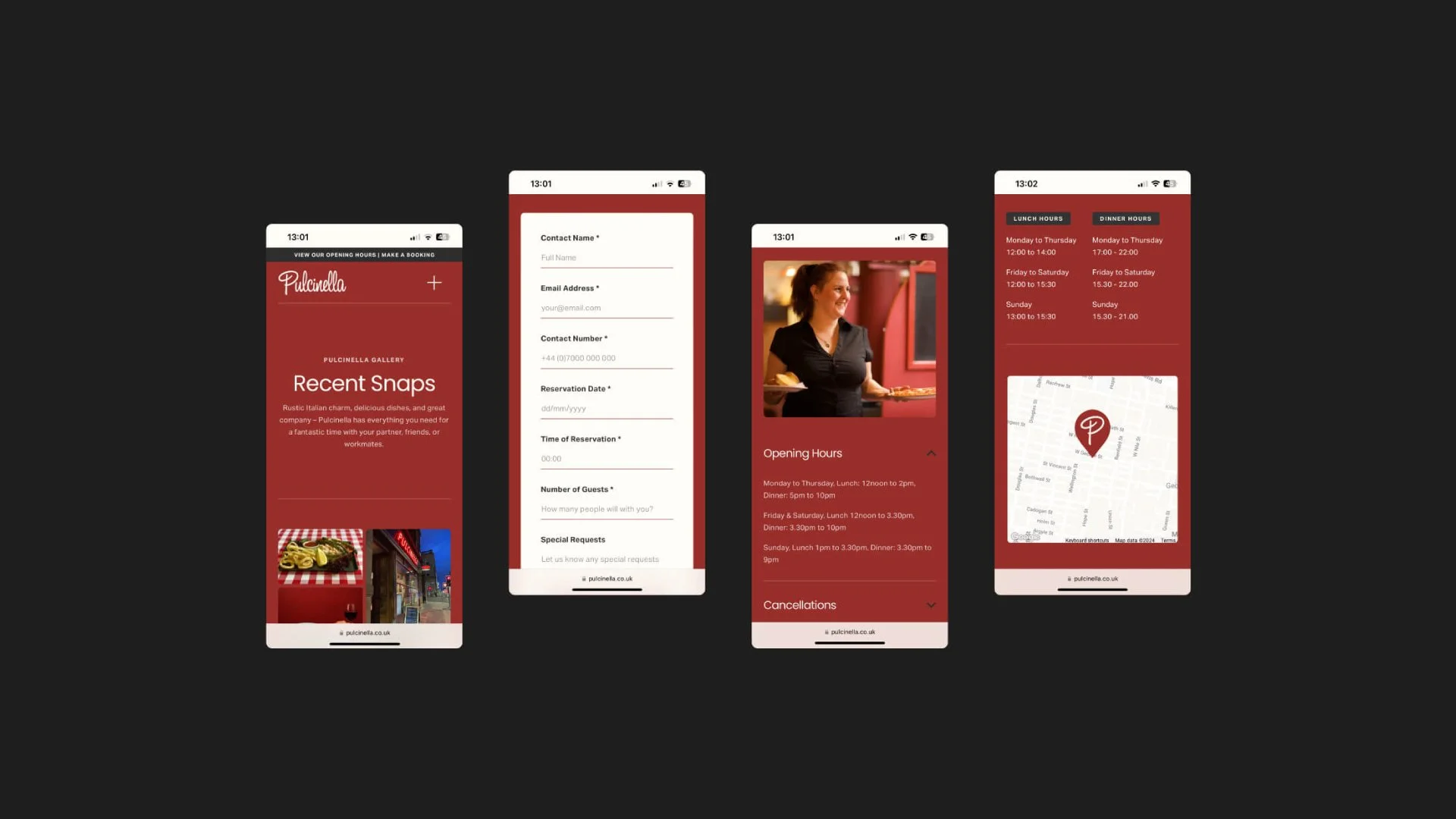
- A real contact page with a map embed, the phone number as a tel: link, and the areas you cover written out.
- Mobile performance. Most local searches happen on a phone, often outdoors on patchy signal. A slow site loses the enquiry before the ranking matters, the fixes for a sluggish Squarespace site are mostly image weight and third-party scripts.
- Clear, legible contrast and type sizes. Accessibility and local conversion overlap more than people expect; readable colour contrast helps every visitor reading your number in sunlight.
For the platform-level settings, URL structure, image filenames, meta descriptions, indexing, the Squarespace SEO fundamentals for small businesses covers the full pass. Do that once before you start building location pages, or you'll be optimising pages that Google can't read cleanly.
Suburb-level targeting outperforms city-wide competition
This is where most local SEO advice stops short. "Glasgow" as a single target is brutally competitive and geographically vague. The city centre, West End, Southside, East End and the surrounding towns behave like separate markets, and searchers use them that way: "electrician Shawlands", "barber West End Glasgow", "joiner Bearsden".
The lazy version of this is thirty near-identical pages with the place name swapped. Google has been discounting that for years and users bounce off it instantly. The version that works:
- Build pages only where you have proof. A page for Paisley needs Paisley photos, a Paisley job described in specifics, and ideally a Paisley review quoted on it. No proof, no page.
- Group sensibly. One strong page covering the Southside with named areas inside it beats five thin pages for Shawlands, Pollokshaws, Govanhill, Battlefield and Mount Florida.
- Write the local detail a local would notice. Tenement flats need different electrical work than new-build estates in East Kilbride. Sandstone needs different treatment than render. That specificity is unfakeable and it's the whole point.
- Link internally from your main service page to each area page, with the area name as the anchor.
- Keep conversion elements on every one. Phone number, form, and recent work. An area page that ranks and doesn't convert is a vanity metric.
Trades benefit most here, because job geography is so visible. A builder's area page with four local projects on it carries the same weight as a portfolio entry — which is why structuring a builder's portfolio page properly doubles as local SEO work rather than sitting beside it.
Track enquiries and profile interactions, not search positions
Rank trackers lie in local search. Results shift by the street you're standing on, so a "position 3" report tells you very little. Track outcomes instead.
| What to track | Where to find it | What it tells you |
|---|---|---|
| Calls, direction requests, website clicks | Business Profile performance tab | Whether the profile is converting attention into contact |
| Search queries triggering your profile | Business Profile performance tab | Whether you're matching the services you want to be found for |
| Impressions and clicks per page, by query | Google Search Console | Which pages and which Glasgow areas are gaining ground |
| Form submissions and phone clicks | Analytics plus your own enquiry log | The number that pays the bills |
| Source of every enquiry | Ask on the call, write it down | The cheapest attribution method and often the most accurate |
Give it a quarter before judging. Profile changes can move within days; content and citation work takes longer to settle.
Most work is DIY; hire for technical gaps or competitive saturation
Most of the checklist above is DIY-able by a business owner with a few focused evenings. Profile setup, review systems, citation cleanup, and writing accurate area pages need local knowledge more than technical skill, and you have the local knowledge.
Paying for help makes sense when the bottleneck is technical (schema, site speed, a platform that won't let you control titles), when you're in a saturated category where everyone has already done the basics, or when the time cost of doing it yourself exceeds what an agency charges. Local SEO engagements are usually sold as monthly retainers or one-off audit-and-fix projects; rates vary widely and move often, so get two or three current quotes rather than trusting a figure in any blog post, including this one.
Red flags worth walking away from:
- Be wary of any promise of a guaranteed number one ranking. Nobody controls the algorithm.
- Refusing to give you admin access to your own Business Profile or Search Console.
- Reporting that leads with impressions and keyword counts instead of calls and enquiries.
- Bulk citation submissions to hundreds of directories as the headline deliverable.
- Any mention of buying reviews.
- No named person doing the work.
The questions worth asking are much the same ones you'd ask any creative supplier, and the vetting questions for a design brief translate almost directly: who does the work, what do you own at the end, what happens if results stall.
FAQ
How long does local SEO in Glasgow take to work?
Profile changes often show faster than content and citation work, which tends to take longer to settle. Category changes and review growth move fastest, which is why local SEO Glasgow work should always start with the profile rather than a site rebuild.
Do I need a Glasgow address to rank locally?
No, but you need a verifiable presence. Service-area businesses can rank without displaying an address, as long as verification holds and your service areas are set accurately. Using a virtual office or a friend's address risks suspension.
Should I build a page for every Glasgow suburb I cover?
Only where you have real work to show. Pages built on substance outperform volume, and a handful of strong area pages will beat thirty templated ones every time.
Does the website platform affect local rankings?
Not directly. What matters is whether the platform lets you control titles, URLs, schema and page speed — most mainstream builders do. A well-built Squarespace site and a well-built WordPress site compete on even terms.
Is social media part of local SEO?
Indirectly. Social profiles act as citations and can drive branded searches, which do influence local visibility. The comparison of organic social and paid ads is a useful read before deciding how much budget to shift there.
Fix your primary category and send five review requests this week
Open your Business Profile, check the primary category, and fix it if it's wrong. Then send review requests to the last five happy customers. Those two jobs take under an hour and they move more than any other hour you'll spend on local SEO in Glasgow.
After that, the harder question is whether your website can convert the visibility you're building. If the enquiries start arriving and the site behind them is slow, dated, or vague about what you do, the ranking work for the local SEO Glasgow campaign just funnels people to a leaky page. That's a website design problem rather than a search one, and it's worth looking at plainly before you pour more effort into getting found.