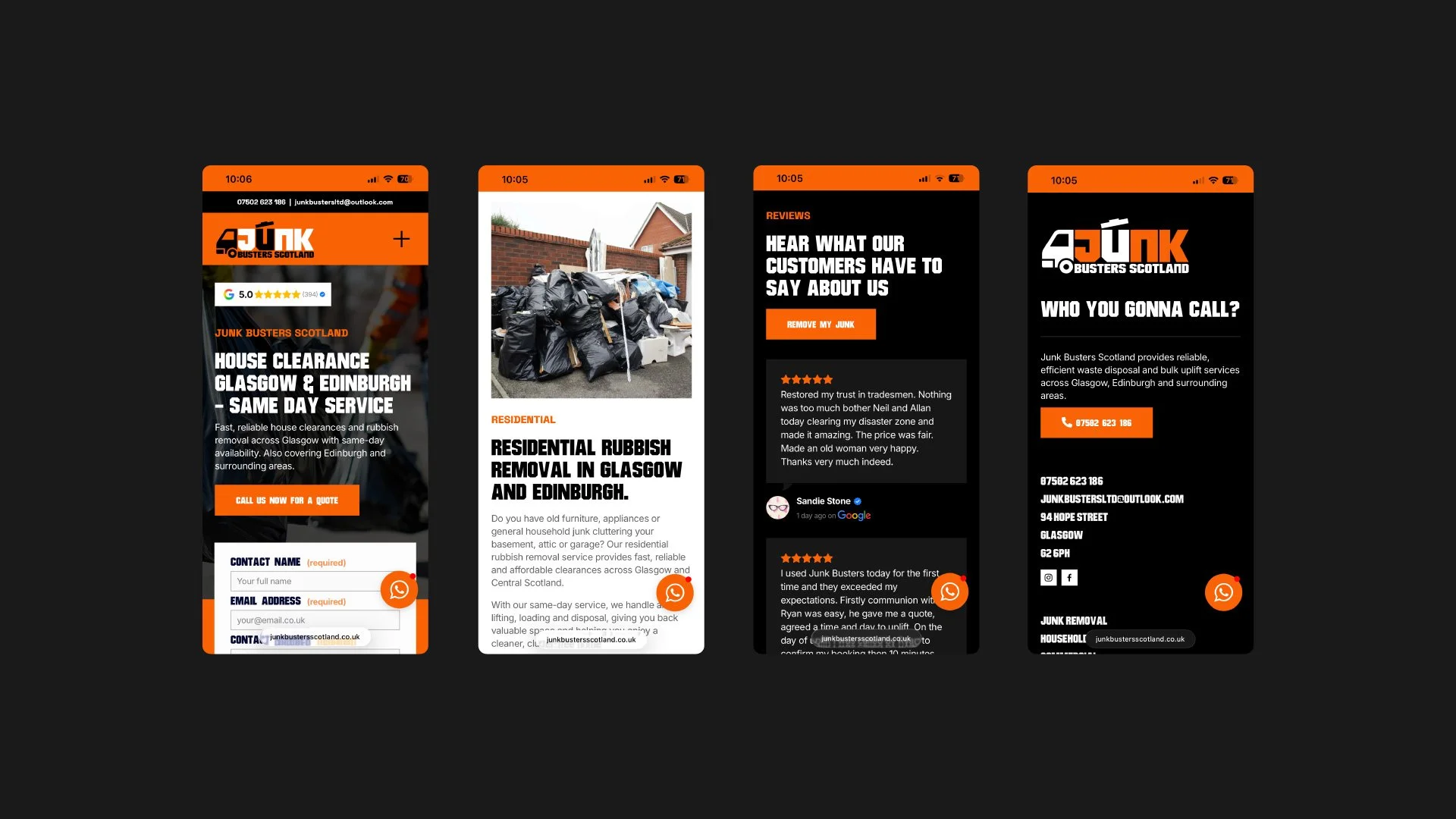
Cheap web design in Glasgow comes in three forms: DIY on a builder, a fixed-price budget package, or a custom build, and each carries a different cost once you count the three years after launch rather than just the price today. Budget packages advertise from the low hundreds but climb fast once pages, forms, booking tools or SEO get added as extras. DIY costs least upfront and suits a new sole trader testing demand, but the hidden cost is the owner's own time learning a template. A website's only real job is converting a phone visitor into an enquiry, through proof of work, frictionless contact, and local search foundations, and a cheap site that nobody finds costs more than an expensive site that books three jobs a month. Domain ownership, hosting access, and what "SEO included" really means matter more than the headline price, and should be confirmed before any contract is signed.
A budget website and a custom-built one can look almost identical in a screenshot. The difference shows up three months later, when one of them is sitting on page four for "joiner near me" and the other is taking quote requests from people who found it on a phone at 7am. If you're searching for cheap web design in Glasgow right now, that gap is the thing worth understanding before you spend anything.
This is a comparison of three real routes a Glasgow trade business can take: building it yourself on a website builder, buying a budget package from a low-cost provider, or commissioning a custom site from a designer. Each gets judged on the same criteria: upfront cost, total cost over three years, how well it brings in work, what you own at the end, and how much of your time it eats.
Cheap Web Design in Glasgow Splits into Three Routes: DIY Builder, Budget Package, or Custom Build
Every quote you'll get in Glasgow falls into one of these buckets, even when the sales page doesn't say so.
- DIY on a builder. You pay a monthly subscription to Squarespace, Wix or similar, pick a template, and do the work yourself. Cost is the subscription plus your evenings.
- Budget package. A low-cost provider sells a fixed-price site, often advertised from a few hundred pounds. Typically a template with your logo, your copy, and your photos dropped in. Fast turnaround, limited revisions, extras priced per item.
- Custom build. A designer plans the site around how your business really wins jobs, then builds it. Higher upfront cost, more of your input needed early, and the site is shaped around your services and service area rather than around a template's layout.
None of these is automatically wrong. A one-man window cleaning round and a 12-van civils contractor have distinctly different needs, and pretending otherwise is how people end up overspending or underspending.
Budget packages advertise low hundreds but climb steeply once you add real functionality
Advertised starting prices in the Glasgow market tend to sit in the low hundreds for budget packages, with the real number climbing once pages, forms, booking tools or e-commerce get added. Check any provider's current pricing page before you plan around a figure, because these move. The pattern is consistent though: the headline price covers a small number of pages on a template, and everything else is a line item.
DIY is the cheapest entry point by a wide margin. A builder subscription typically costs less per month than a single callout from a tradesperson, and you can be live in a weekend if you already have decent photos and you know what you want to say.
Custom sits at the other end. You're paying for the thinking, the structure, and the design work that makes a site convert, not for the pages themselves. A well-built site for a trade business is mostly invisible labour: service page architecture, local search setup, the order information appears in, the way a quote form is written.
| Criterion | DIY builder | Budget package | Custom build |
|---|---|---|---|
| Upfront cost | Lowest (subscription only) | Low, rises fast with add-ons | Highest |
| Your time required | Very high | Low | Moderate, front-loaded |
| Design control | Full, but limited by skill | Low, template-bound | Full |
| SEO foundations | Depends entirely on you | Usually minimal | Built in from the start |
| Ownership clarity | Clear (your account) | Often murky | Should be contractual |
| Best for | New sole traders testing demand | A basic presence, fast | Businesses chasing inbound work |
Three-year cost often flips the ranking because DIY hides your time investment
Comparing upfront prices only tells you who charges least to start. Run each option forward 36 months and the ranking often changes.
- With DIY, the subscription is predictable and that's the whole bill. The hidden cost is yours: hours spent fiddling with a template at 10pm instead of quoting jobs or sleeping. If an hour of your time has any value at all, forty hours of learning curve is not free.
- Budget packages are where the sums get awkward. The entry price is truly low, but Glasgow providers routinely price extras separately: additional pages, a quote or invoice system, live chat, social integration, SEO work, hosting, ongoing edits. A site that started cheap can climb substantially once you've added the three things you needed from the start. Then there's maintenance: if every text change goes through the provider at an hourly rate, you'll either pay repeatedly or let the site go stale.
- Custom costs more day one and tends to flatten after that. You get a site you can edit, a structure that doesn't need rebuilding when you add a service, and no per-change fee for swapping a phone number. The plain caveat is that this only holds if the build was done properly; a badly-built expensive site has all the same problems as a badly-built cheap one, plus a bigger invoice.
Only conversion to actual phone calls proves the spend was worth it
This is the only criterion that decides whether the spend was worth it, and it's the one the Glasgow price-led market barely mentions. A website for a trade business has one job: turn someone who found you on their phone into someone who contacts you. Everything else is decoration.
Three things do most of that lifting, and none of them are expensive to include if they're planned in from the start:
- Proof of work. Real photos of real jobs, with enough context that someone can picture you doing theirs. A properly structured project gallery with short case studies outperforms a stock-photo hero image every single time.
- Frictionless contact. Click-to-call that works on a phone, a quote form that asks the right questions, and a response path that doesn't require someone to find an email address in a footer. The features that convert enquiries for contractors are mostly unglamorous mechanics.
- Local search foundations. Separate pages for separate services, place names used where they belong, a Google Business Profile wired to the site, page titles that match what people type. Getting your Google Business Profile set up properly often moves the needle faster than the website redesign itself.
A budget package usually delivers the first of those and half of the second. Local SEO is almost always an upsell, because doing it properly takes research time that a fixed low price can't absorb. DIY can deliver all three if you're willing to learn, and the basics of Squarespace SEO are learnable in an afternoon. Custom should deliver all three as standard, and if a designer quoting you doesn't mention service pages or local search at all, that's a signal.
A cheap site that nobody finds costs more than an expensive site that books three jobs a month. Price is only meaningful next to return.
Demand domain and hosting ownership before signing any cheap web design contract
Low price isn't the problem. Low price hiding structural compromises is. Before signing anything with a Glasgow provider, get clear answers on these:
- Domain ownership. The domain should be registered to you, in your name, on an account you can log into. If the provider registers it on your behalf and holds the login, leaving them later becomes a negotiation.
- Who holds the hosting account. Same principle. Paying a provider's hosting fee is fine; being unable to access the account isn't.
- What happens to the site if you stop paying. Some low monthly offers are effectively rentals; stop the direct debit and the site disappears. That can be a reasonable deal, but you need to know it's the deal.
- Edit rights. Can you change your own phone number, prices and photos, or does every change cost? For a trade business whose service area and team size shifts, this matters more than it sounds.
- Contract length and exit terms. A twelve-month minimum on a site you dislike after month two is a long year.
- What "SEO included" means. Ask what specifically will be done. "SEO optimised" with no further detail usually means meta titles were filled in.
Ask these on the first call. A good provider at any price point will answer them plainly, and the ones that get vague have told you something useful.
DIY wins for new traders testing whether websites bring phone calls at all
There's a version of the budget decision that gets dismissed too quickly: build it yourself and spend nothing on design at all. For a sole trader in the first year, testing whether the phone rings from a website at all, this is a defensible call. The subscription is small, you keep full control, and you learn what your customers really ask before paying someone to design around guesses.
Squarespace handles the technical floor for you: mobile responsiveness, hosting, security certificates, reasonable page speed out of the box, which removes most of the ways a self-built site goes wrong. There's a reason it's the platform behind a lot of small business sites, and the case for building on Squarespace is mostly about what you don't have to think about.
Be clear-eyed about the limits, though. Templates nudge everyone toward the same layouts, so your site risks looking like your competitor's. Writing your own service copy is harder than it looks. And the gap between a site that exists and a site that converts is almost entirely design and structure judgement, which is exactly the thing you're choosing not to buy.
Custom design pays for itself when you can name the specific problem it solves
Custom makes sense when the website has a measurable job to do and you can name it. Three vans sitting idle in February. Enquiries coming in for work you don't want. Every lead arriving through word of mouth and nothing from search. A quote form that gets filled in by tyre-kickers because it asks the wrong questions.
At that point you're not buying pages, you're buying the decisions: which services get their own page, what order the homepage makes its argument in, which trust signals go above the fold, how a visitor from a Google search of "emergency electrician Glasgow" lands somewhere relevant rather than on a generic home page. That's the work behind projects like the MacGregor Building Services site or Alistair Electrical, where the structure was shaped around the services that bring in the best jobs.
It's also worth saying that a custom website built on top of weak branding is a half-measure. If your logo was knocked up in an afternoon five years ago and your van livery, quotes and site all say different things, the website can only do so much. Brand first, site second, is usually the cheaper order of operations even though it feels like the slower one.
Match your business stage to the route, not your budget to the headline price
Match your situation to the route, not your mood to the price.
| Your situation | Choose | Why |
|---|---|---|
| Just started, no budget, testing demand | DIY builder | Lowest risk, full control, you learn what customers ask |
| Established but need any web presence this month | Budget package | Fast and functional, as long as ownership terms are clean |
| Steady referrals, want inbound search work | Custom build | Local SEO and conversion structure are the whole point |
| Multiple trades or service areas | Custom build | Service page architecture can't be retrofitted cheaply |
| Site exists but generates nothing | Custom rebuild | The problem is almost always structure, not visuals |
| Tight budget but serious growth plans | DIY now, custom later | Spend on branding first, build the proper site when revenue supports it |
One more consideration before you decide: how you're currently getting work. If Facebook is bringing in every job and the website would sit unused, that changes the maths; the trade-offs between a website and social media for trades are worth weighing before you commit a budget to either.
Frequently asked questions
How much does cheap web design in Glasgow typically cost?
Cheap web design in Glasgow commonly advertises starting prices in the low hundreds of pounds, with add-ons like extra pages, booking systems and SEO priced separately. Always check the provider's live pricing page, since these figures change. The more useful question is what the total lands at once you've included everything your business needs — that number is often significantly higher than the headline once real requirements are added.
Is a freelancer or an agency better for a low-budget website?
A freelancer is usually the stronger value at the lower end, because there's no account manager layer and you deal directly with the person designing your site. Agencies make more sense when you need multiple disciplines running at once or you have a large site to maintain. For a trade business under ten staff, a single designer who understands local search will generally get you further per pound.
Do cheap packages include hosting, SEO and maintenance?
Sometimes hosting, rarely meaningful SEO, and maintenance almost always costs extra. Get it in writing. "SEO included" can mean anything from a full keyword and local search setup to filling in page titles, so ask for the specific list of tasks before you compare two quotes.
Can I start cheap and upgrade later?
Yes, and it's often sensible — but only if you own the domain and control the hosting account from the start. Migrating a site you own is routine. Extracting one from a provider who holds every login is not. Keep your branding assets in open file formats too, so a future designer isn't starting from a screenshot of your logo.
What's the single biggest mistake trade businesses make with a budget site?
Treating the website as a brochure rather than a lead channel. A page that lists services with no proof, no clear call, and no local search structure will sit there doing nothing regardless of whether it cost £299 or £2,999. Decide what the site needs to achieve first, then price against that.
Define your website's one job before comparing any quotes
Before you compare another quote, write down the one job your website has to do over the next twelve months — book more bathroom fits, pull in commercial work rather than domestic, get you found for a specific area of Glasgow. Then ask every provider you speak to, cheap or otherwise, how their proposal does that specific thing. The answers will separate the options faster than any price list.
If the plain answer is that you're not sure yet what the site should achieve, that's worth sorting out first. Have a look at how a brand and website project really runs, or start a conversation about what your trade business needs before committing a budget to cheap web design in Glasgow that may not be aimed at anything.